Cognitive Robot Abstract Machine (CRAM)#
Monorepo for the CRAM cognitive architecture.
A hybrid cognitive architecture enabling robots to accomplish everyday manipulation tasks.
This documentation serves as a central hub for all sub-packages within the CRAM ecosystem.
About CRAM#
The Cognitive Robot Abstract Machine (CRAM) ecosystem is a comprehensive cognitive architecture for autonomous robots, organized as a monorepo of interconnected components. Together, they form a pipeline from abstract task descriptions to physically executable actions, bridging the gap between high-level intentions and low-level robot control.
Installation | Contribute | Github
Architecture Overview#
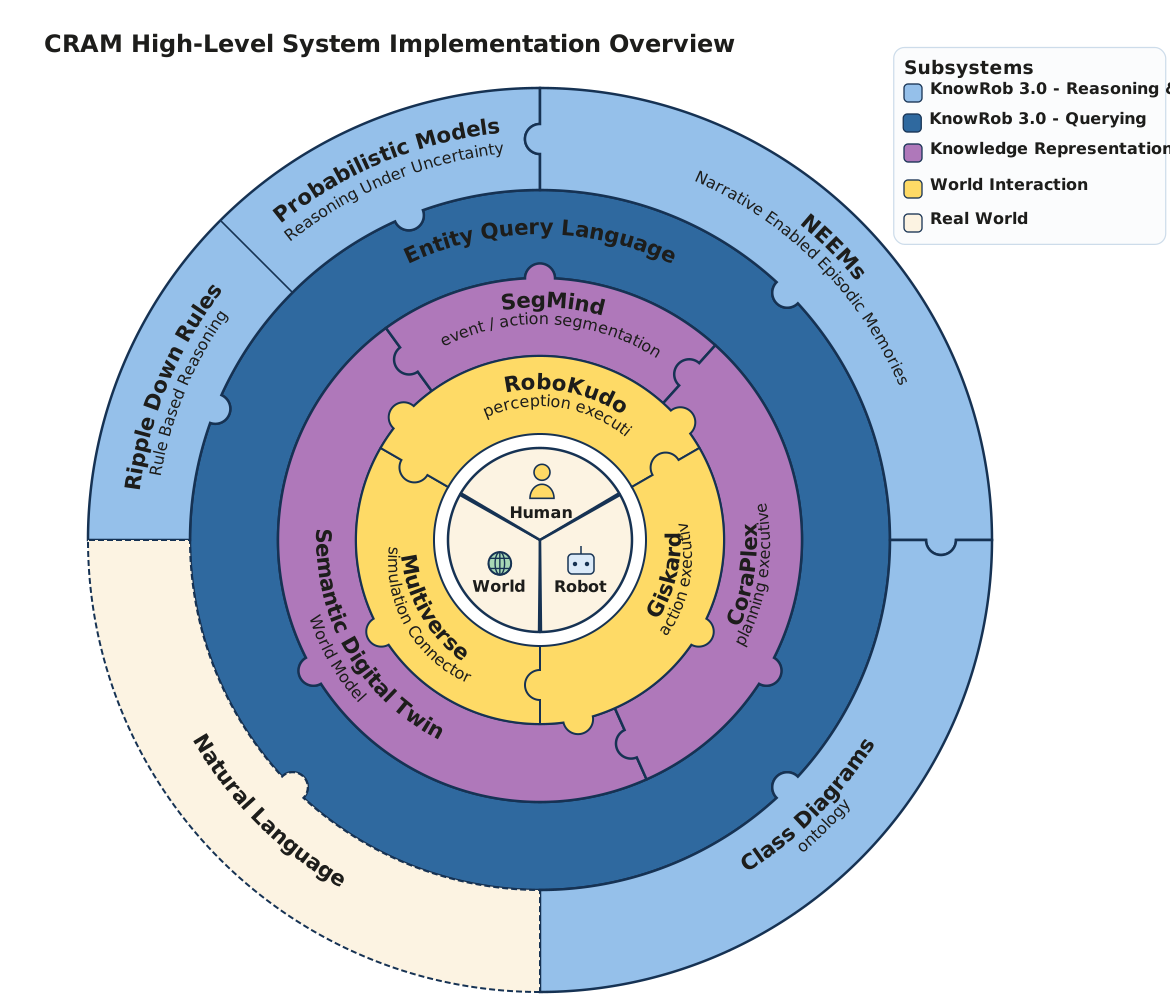
CRAM consists of the following sub-packages:
CoraPlex: is the central control unit of the CRAM architecture. It interprets and executes high-level action plans using the CRAM plan language (CPL).
The Semantic Digital Twin is a world representation that integrates sensor data, robot models, and external knowledge in form of semantic annotations to provide a comprehensive understanding of the robot’s environment and tasks.
Giskardpy is a Python library for motion control for robots. It uses constraint- and optimization-based task-space control to control the whole body of a robot.
KRROOD is a Python framework that integrates symbolic knowledge representation, powerful querying, and rule-based reasoning through intuitive, object-oriented abstractions.
Probabilistic Model is a Python library that offers a clean and unified API for probabilistic models, similar to scikit-learn for classical machine learning.
Random Events is a Python library to provide a simple and flexible way to generate events that are suitable for probabilistic reasoning.
Installation#
To install the CRAM architecture, follow these steps:
Set up the Python virtual environment:
sudo apt install -y virtualenv virtualenvwrapper && \
grep -qxF 'export WORKON_HOME=$HOME/.virtualenvs' ~/.bashrc || echo 'export WORKON_HOME=$HOME/.virtualenvs' >> ~/.bashrc && \
grep -qxF 'export VIRTUALENVWRAPPER_PYTHON=/usr/bin/python3' ~/.bashrc || echo 'export VIRTUALENVWRAPPER_PYTHON=/usr/bin/python3' >> ~/.bashrc && \
grep -qxF 'source /usr/share/virtualenvwrapper/virtualenvwrapper.sh' ~/.bashrc || echo 'source /usr/share/virtualenvwrapper/virtualenvwrapper.sh' >> ~/.bashrc && \
source ~/.bashrc && \
mkvirtualenv cram-env
Activate / deactivate
..code:: bash
workon cram-env
deactivate
Install using UV#
To install the whole repo we use uv (astral-sh/uv), first to install uv:
# On macOS and Linux.
curl -LsSf https://astral.sh/uv/install.sh | sh
then install packages:
uv sync --active
Alternative: Poetry#
Alternatively you can use poetry to install all packages in the repository.
Install poetry if you haven’t already:
pip install poetry
Install the CRAM package along with its dependencies:
poetry install
Contribute#
Before contributing please check our guidelines on how to contribute to CRAM.
About the AICOR Institute for Artificial Intelligence#
The AICOR Institute for Artificial Intelligence researches how robots can understand and perform everyday tasks using fundamental cognitive abilities – essentially teaching robots to think and act in practical, real-world situations.
The institute is headed by Prof. Michael Beetz, and is based at the University of Bremen, where is is affiliated with the Center for Computing and Communication Technologies (TZI) and the high-profile area Minds, Media and Machines (MMM).
Beyond Bremen, AICOR is also part of several research networks:
Robotics Institute Germany (RIG) – a national robotics research initiative
euROBIN – a European network focused on advancing robot learning and intelligence
Research & Publications#
Acknowledgements#
This work has been partially supported by the German Research Foundation DFG, as part of Collaborative Research Center (Sonderforschungsbereich) 1320 Project-ID 329551904 “EASE - Everyday Activity Science and Engineering”, University of Bremen (http://www.ease-crc.org/).